Your world is gone, erased. The Oneiron Expanse is all that stands now and hears you dreaming. Shape reality with your thoughts, face the void, and find the Dreamwright — before you forget why you're fighting for.
The (short) Story
You were just doing your job. Unpacking boxes for a living. Clocking hours. Trying to get home to your loved ones.
Then your reality abruptly ended, consumed by The Void.
Now you stand in the Oneiron Expanse — a shattered desert of impossible stars, living stone, and forgotten worlds — holding a dagger that whispers in your mind. Your universe has been erased, devoured by entities that consume existence itself. Everyone you loved is gone.
Except your memory.
In this world, power isn’t cast. It’s daydreamed.
As a Transcended, you shape reality the way dreams do — through thought, belief, and emotion. Channel your will through an ancient blade and wield four dangerous Dream Essences: Nightmare, Dissonance, Lucid and Liminal. Each one bends the Oneiron Expanse in a different way — and each one takes something from you in return.
Explore surreal landscapes suspended in the void. Make impossible choices that define who you become — and what you’re willing to sacrifice to fight back against oblivion itself.
You cannot save your world.
But you can decide what kind of savior you become.
Strong Narrative, Choice Always Matters
The game is not story-driven and narrative does not get in the way of combat and fun, but flows with it. It is to become an experience where player decisions shape the journey, its capabilities and skills. Choices aren’t cosmetic—they echo forward, alter outcomes, and leave lasting consequences.
True Player Agency, Not Dice Dependency
Combat and deckbuilding reward intention and planning, not luck. You control your tools and outcomes, while the world, encounters, and paths remain unpredictable — keeping every run fresh without stealing your agency.
Easy to Learn, Deep Enough to Master
Simple mechanics make Project Dreamwright immediately approachable, but layered systems and broad set of interactions offer immense tactical depth for players who want to push the Oneiron Expanse to its limits.
Seeing it & touching it, in hi-fi changes everything
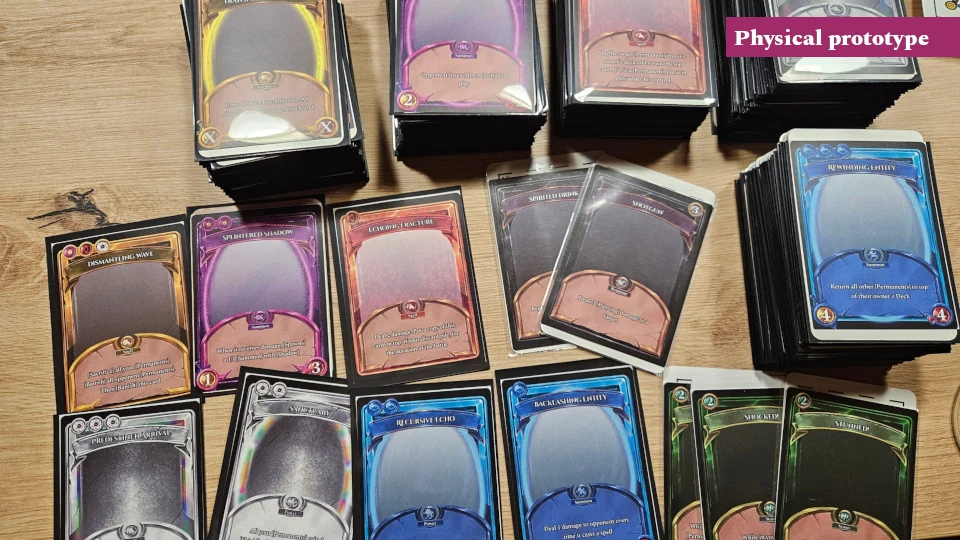
For weeks, we’ve been paper prototyping our mechanics with low-fi cards. It worked, but moving into this refinement phase—seeing the art "fit" the gameplay—has been a massive shift. After seeing the integration in-game, we quickly decided to override the low-fi paper prototype and test it again.
It turns out that when the art moves past placeholders, it’s actually much easier to spot typos, narrative issues, wording, logic issues, and subtle misbalances. Even without illustrations, the clarity is a game-changer.
We managed to craft over 400 cards in just two days to get this prototype ready, largely thanks to the Reliquary board for Figma (massive credit to Clint @eerieisland for building such a powerhouse tool).
- Note: The art shown is not yet final but a concept exploration derived and inspired by the incredible work of @pixartsnet on DeviantArt. -
Now, we’re heading into a closed physical playtest to stress-test the "fun" before we lock things down in-engine. It’s still a work in progress, but the momentum feels real.
After deep technical exploration and several internal prototypes, we've made a clear decision on our tech stack.
We're building our game on Godot 4 as our core engine.
For a 2D, systems-driven game like ours, iteration speed and architectural clarity are everything. Godot 4 gives us the flexibility to move fast while keeping the codebase structured and scalable. It allows us to prototype quickly, validate mechanics early, and refine gameplay without unnecessary overhead.
Over the past weeks, we've been refactoring and strengthening the core systems — including the card engine and bot intelligence. The result: tighter gameplay loops, faster iteration cycles, and a more resilient foundation for long-term development.
As indie builders, choosing the right tools is about leverage. We want a stack that lets us ship consistently, experiment boldly, and maintain quality as complexity grows. Godot 4 aligns with that philosophy.
Big appreciation to the Godot community — the tooling, documentation, and openness of the ecosystem make ambitious indie projects possible.
If you're building with Godot or working on systems-heavy games, let's connect.
And if you're interested in playtesting a strategic card game built in public, drop a comment in our Discord server — our first playtest is coming soon..
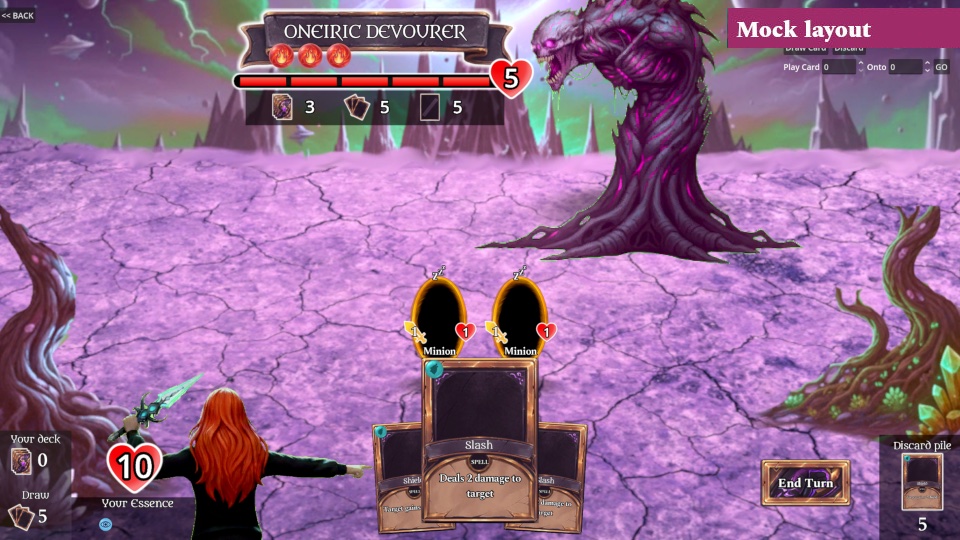
Early in development, we put together a series of quick mockups to explore different combat layouts. After gathering initial player feedback, one direction stood out: a vertical scene composition that mirrors a head-to-head card match, with each side representing a distinct deck.
This wasn’t just a visual choice — it reflects a core pillar of our design.
In our game, enemies aren’t pre-scripted creatures running through predictable ability rotations. They aren’t “prebaked” encounters with fixed patterns to memorize. Instead, each enemy has its own custom-built deck and plays it as a real contender would — drawing from its pool of possibilities and adapting its strategy to overcome you.
By laying out the battlefield vertically, we reinforce that philosophy. The scene reads like a 1v1 duel between two intelligent forces. The symmetry and perspective aim to communicate parity: you’re not solving a puzzle, you’re facing an opponent. One that has access to powers comparable to yours, and the agency to use them meaningfully.
Our hope is that this framing makes every encounter feel like a clash of minds — a tense, fair fight against a smart, relentless entity that plays by the same rules you do.
As always, we’d love to hear your thoughts — especially from players who crave that feeling of true back-and-forth competition.
This week we've finished the first playable bot. It is a rewarding experience when one can play this game in digital form and there's an evil mind trying to beat you.
Now we can finally abandon the paper prototype and experiment with the digital form. It will not only become one day a fierce contender to all of you, but in the meantime will help us balance the cards and mechanics we make.
Here's an unexciting image of how it allows us to play while we don't have the visuals in place yet.
Welcome to our first development update! We're thrilled to share our progress on Dreamwright. Over the past months, we've been hard at work establishing the core mechanics and visual identity of our roguelite deckbuilder adventure.
We’ve gone from research and paper prototypes to a working digital greybox prototype. We've been focused on crafting a strong narrative, a simple but deep combat system and establishing the main pillars for the game.
And we’re now preparing our first public playtest, launching in few weeks in itch.io.
This early version is raw and systems-driven, designed for players who enjoy helping shape games from the start. If you’re curious, we’ll be sharing development updates, behind-the-scenes progress, and playtest access very soon.
We build games with our community from day one. Got an idea, feedback, or just want to chat? Drop us an email or join us on Discord — we’d love to hear from you.